Inês Valente
PhD Candidate at NOVA University of Lisbon

Inês Valente holds a master’s degree in Environmental Engineering from NOVA-FCT. She started working as a researcher in 2022 and is current part of the Energy and Climate group at CENSE – Center for Environmental Research and Sustainability, NOVA-FCT – NOVA University of Lisbon. Her research topics cover energy efficiency financing schemes, energy and thermal comfort vulnerability, and energy efficiency one-stop shops. She has contributed to several national and European projects in these areas, such as the Energy Poverty Advisory Hub (EPAH), the LIFE HORIS project, which aimed to develop digital One-Stop Shops for home renovation, provided support for national energy efficiency financing schemes for general population (PAE+S II and PAE+S 2023) and targeted to vulnerable population (Vale Eficiência) and is involved in the development and monitoring process of a local financing scheme in a municipality of Cascais (Fundos Verdes Cascais). She is the author of two peer-reviewed articles and a co-author of several reports addressing the aforementioned topics. She has experience in data collection and engagement with vulnerable populations, having conducted surveys among youth concerning energy poverty and thermal comfort in schools. Furthermore, she has completed a course in ethnographic research and participated in a 10-day field study focused on collecting data related to citizens’ perceptions of energy and sustainability.
Methodology for the identification of EU regions with higher vulnerability to severe energy poverty [2026]
Assessment of EU regions with higher vulnerability to severe energy poverty [2026]
EPAH - Residential energy efficiency and energy poverty in the EU: Building conditions, thermal comfort, and vulnerable groups [2026]
EPAH - Expanding energy poverty measurement in the EU: Integrating new climate, health, and mobility indicators [2026]
EPAH Energy Poverty Indicators Leaflets (2026) [2026]
Supporting the energy renovation journey - The role of HORIS one-stop shops [2026]
EP MED - Catalysing cross-sectoral networks of national observatories and regional hubs to coordinate actions against households energy poverty in EU Mediterranean countries (LIFE) [2026-2029]
EP-MED tackles household energy poverty across Mediterranean EU countries (Portugal, Spain, Italy, Cyprus) through a 36-month, CINEA-funded LIFE action. The consortium of 12 full and 6 associated partners will assess vulnerable households, deliver interventions including energy efficiency kits (LED lamps, water-aerating taps, thermometers), build local stakeholder capacity, and generate policy recommendations, aiming to reduce energy vulnerability and inform replicable, evidence-based policy across the region.EPAH EU Energy Poverty Advisory HUB [2025-2028]
The European Commission's initiative, Energy Poverty Advisory Hub (EPAH), is the leading EU initiative to eradicate energy poverty and accelerate the just energy transition in European local communities. EPAH’s mission is to be the central platform of energy poverty expertise in Europe for local communities and all stakeholders interested in taking action to combat energy poverty in Europe by providing direct support, learning opportunities, and research results, and by building a collaborative network of stakeholders interested in taking action to combat energy poverty in Europe.Energy Inclusion (Inclusão Energética)_Social Impact Bounds [2026-2028]
The project addresses energy poverty across four Portuguese regions (Centro, Algarve, Norte and Alentejo) and funds home renovation interventions to improve thermal comfort and energy efficiency. Renovation works will be done by volunteers. The project then measures the health, comfort and energy impact of these renovations through a structured before-and-after evaluation, submitted as a Social Impact Bond (Títulos de Impacto Social) under the Portugal Inovação Social programme.DOOBRA 2.0 – Community Laboratory for Energy Action [2026-2028]
DOOBRA 2.0 tackles energy poverty in Lisbon by combining energy literacy, personalised household support, energy efficiency measures and community participation. The project works through local organisations and community leaders to empower vulnerable households and co-create practical, locally grounded solutions.Fundos Verdes Cascais_Municipal Energy Efficiency Funding Scheme [2023-2027]
Support the development of an energy efficiency support scheme for familiesEnergy Poverty Vulnerability Mapping for Portugal - Portuguese Energy Poverty Observatory (ONPE-PT) [2025-2027]
This project develops a national energy poverty index and maps energy poverty across Portugal at the district and municipality levels, covering mainland Portugal, the Azores, and Madeira. The work also discusses the indicators defined in the ELPPE (Estratégia de Longo Prazo para o Combate à Pobreza Energética, Portugal's national long-term strategy against energy poverty), spanning primary indicators (inability to keep the home adequately warm, poor energy performance of dwellings, damp/mould/rot problems, thermal discomfort in summer, and high energy expenditure burden) and contextual indicators (poverty risk, utility debt, disconnections, self-supply from renewables, and energy literacy).May
202620
LIFE HORIS project Final Event in Brussels, May 20
Mar
202619
Multiple Research Presentations at the 9th Annual Conference of the Portuguese Association for Energy Economics (APEEN)
Mar
202617
5th Energy Poverty Advisory Hub (#EPAH) Annual Conference!
Mar
202609
Invited speakers at the JORTEC Ambiente - Sustainable Cities
Feb
202616
EPAH 2026 Technical Assistance – Call for Applications Now Open!
Sep
202526
European Researchers Night 2025
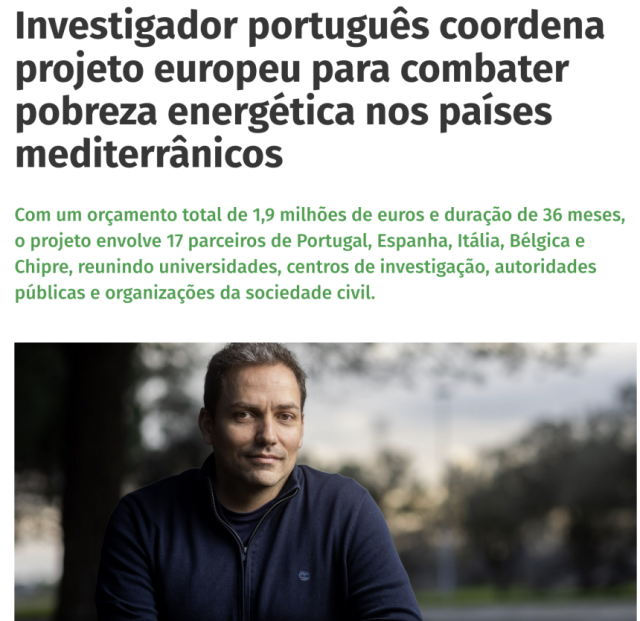
João Pedro Gouveia coordinates new European project to fight energy poverty in Mediterranean countries

Our research highlighted at the 2024 NOVA Sustainability Report

INTELCITIES: Plataforma Renovar Casa - Horis

New EPAH Video.

Lançamento oficial do balcão único digital "Renovar Casa", que promete revolucionar a renovação de habitações em Portugal, Espanha e Itália!
