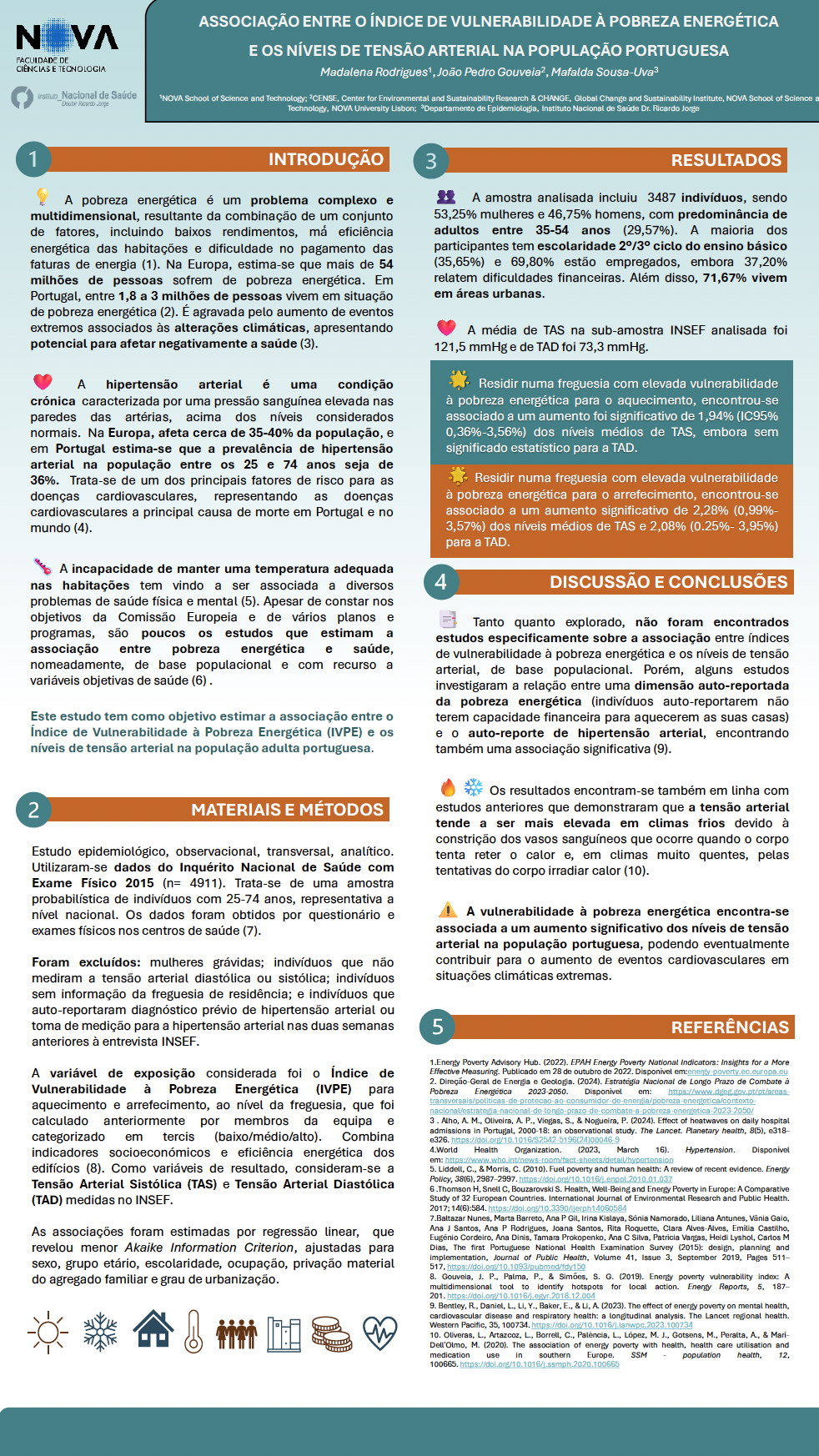
Associação entre o Indice de Vulnerabilidade à Pobreza Energética e os niveis de tensão arterial na população portuguesa. [2025]
We lead scientific coordination of the EU Energy Poverty Advisory Hub, drive Portugal's first Hydrogen Valley, and conduct research informing national energy efficiency policies and decarbonisation strategies.
Introduction: In Portugal, between 1.8 to 3 million people live in energy poverty. This is a consequence of poor building energy performance, low incomes, and high energy prices. It is aggravated by the increase in extreme events associated with climate change, presenting potential to negatively affect health. This study estimated the association between the Energy Poverty Vulnerability Index (EPVI) and blood pressure levels in the Portuguese adult population.
Methods: Data from the 2015 National Health Survey with Physical Examination were used, with measurement of systolic (SBP) and diastolic (DBP) blood pressure (n=3,487). The EPVI for heating and cooling, at the parish level, was previously calculated by team members (low/medium/high). Associations were estimated by linear regression, adjusted for sex, age group, education, occupation, household material deprivation, and urbanization.
Results: Residing in a parish with high vulnerability to energy poverty for heating was found to be associated with a significant increase of 1.94% (95% CI 0.36%-3.56%) in average SBP levels, although without statistical significance for DBP. Residing in a parish with high vulnerability to energy poverty for cooling was found to be associated with a significant increase of 2.28% (0.99%-3.57%) in average SBP levels and 2.08% (0.25%-3.95%) for DBP.
Discussion: Few studies exist on these associations, considering energy poverty and objective health variables. The results are in line with previous studies that demonstrated that blood pressure tends to be higher in cold climates due to blood vessel constriction that occurs when the body tries to retain heat, and in hot climates, due to the body's attempts to radiate heat.
Conclusions: Vulnerability to energy poverty is associated with a significant increase in blood pressure in the Portuguese population, potentially contributing to increased cardiovascular events in extreme weather situations.
Citation : Rodrigues, M., Gouveia, J.P., Sousa-Uva, M. (2025). Associação entre o Indice de Vulnerabilidade à Pobreza Energética e os niveis de tensão arterial na população portuguesa. 1st National Congress on Health and Environment, Lisbon, Portugal, February 7th and 8th, 2025
 Poster_MR_Correto.pdf